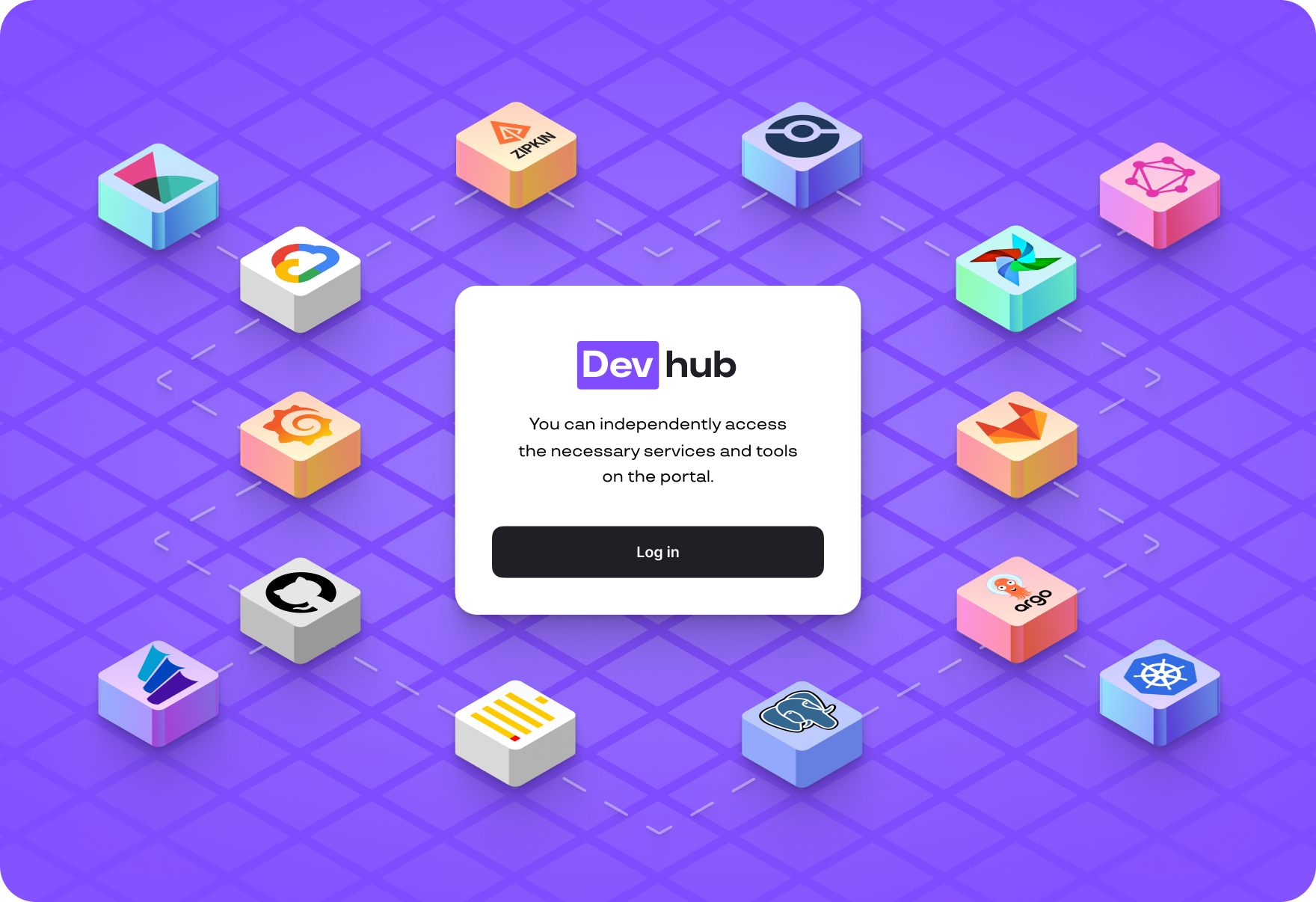


Devhub
A portal for developers. An internal product that helps to quickly gain access
Context
At Uzum, all access requests went through Jira Service Management (JSM). Developers regularly faced issues with obtaining access. It was decided to create an internal portal for access requests and subsequently scale it into an infrastructure portal.
MY ROLE
Lead designer
TIMELINE
Apr – Aug 2024
Business goals
- Create a single place to assist developers
- Reduce the burden on DevOps
- Address the issue of slow and inconvenient access issuance
- Consolidate all service data into one knowledge base
Results


Automated the issuance of access rights
Reduced the time to obtain access to just a few minutes
Created a unified database of all services and their responsible parties
Launched a single platform for implementing additional tools
Research
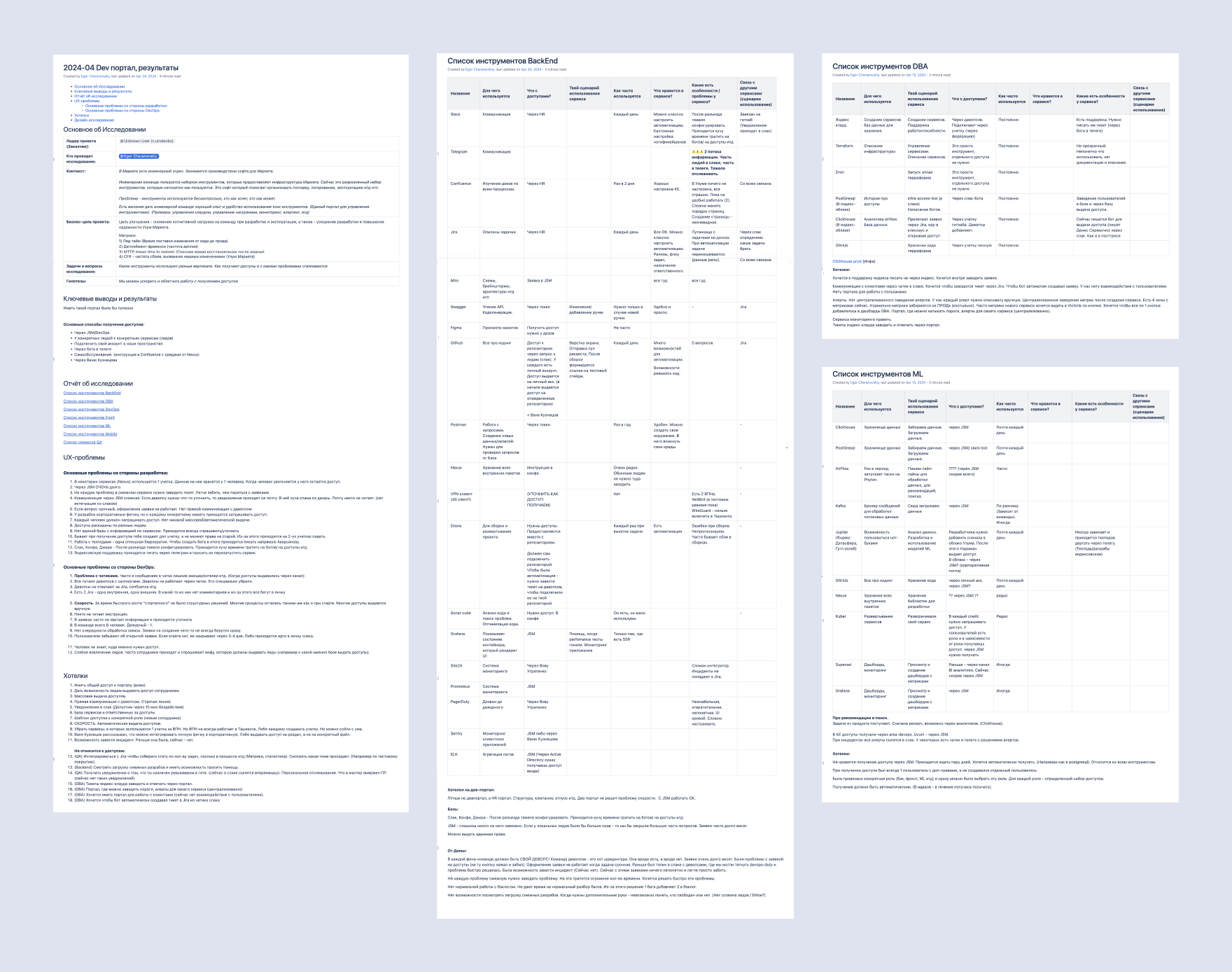
At the initial stage, the client did not understand where to start with the implementation of the portal. Therefore, I conducted extensive research, including over 10 interviews. I surveyed all developer verticals—from QA and frontend to ML. The goal was to understand how the access request process works and what problems arise at different stages.
Key insights
There are issues on both the user side and the DevOps side:
- There is no single place for obtaining access. Six different methods are used to gain access.
- Access through JSM takes an average of 3 to 14 days and requests are often lost.
- There is a lack of information about services and who is responsible for them.
- DevOps lacks personnel to process all requests on time.
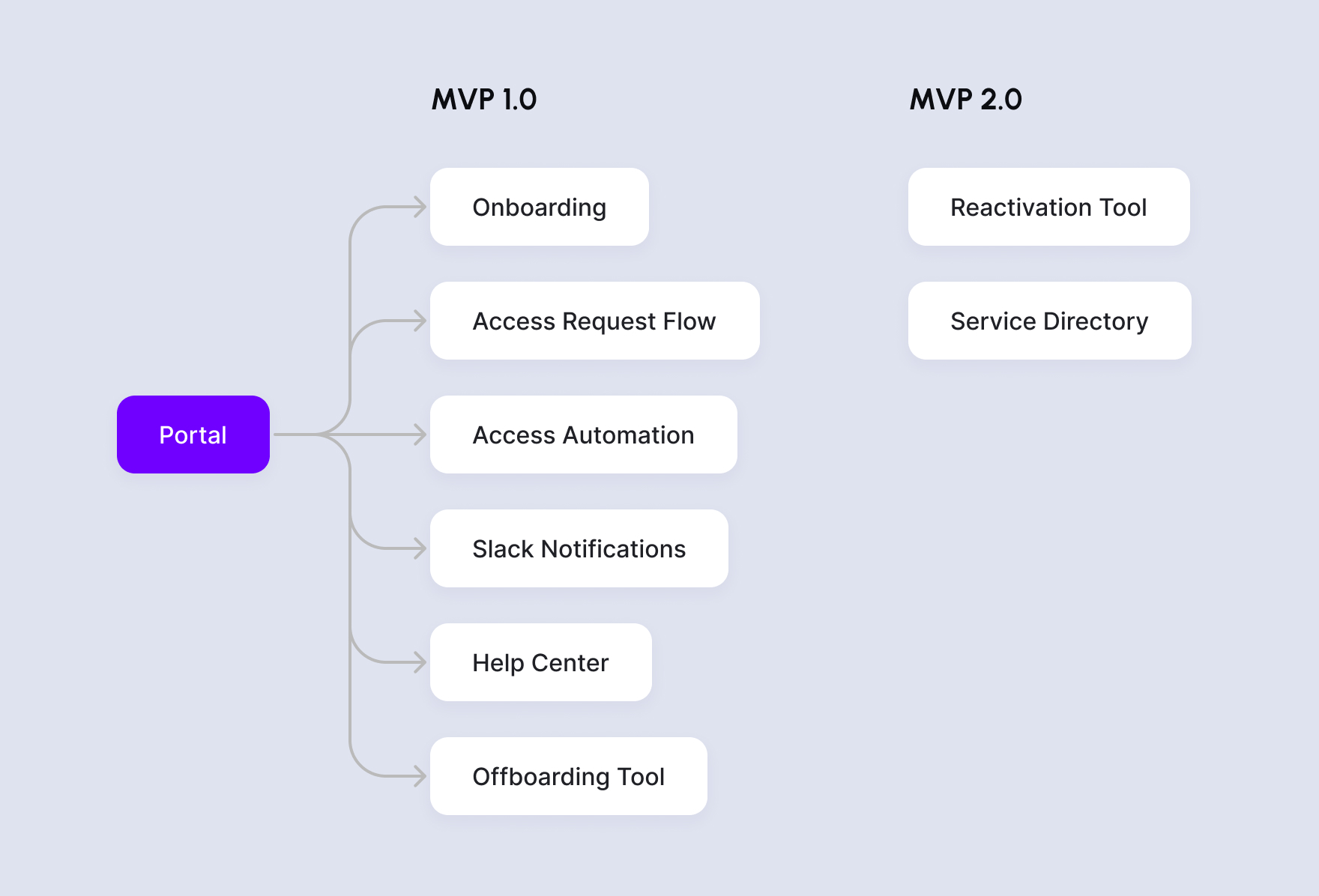
As a result of the research, we held an additional meeting with the client and defined the functionality for the MVP.
Conception
Main idea
The portal as an "infrastructure map". It brings together services, environments, and roles, helping users quickly find what they need and request access.
Tone of communication
Friendly and lively — "the portal = your bro, your buddy".
Navigation in the catalogue
By tags, environments, and roles.
Challenges
- The idea was raw, lacking clear objectives.
- The main clients are developers. They have a "technical" mindset.
- The logic of search and the catalogue is very complex.
- Scalability needed to be built in from the start.
- A new team, processes are not established.
Design
Creating a request
Problem
A quick and clear search for roles across all services is needed.
Challenge
Services vary greatly in structure, and roles differ in meaning and context. A standard hierarchical catalog was not suitable.
Solution
- We created a unified flat catalog of all services and roles.
- To facilitate searching, we added filters and tags for each role.
- Tags were duplicated in role names to allow searching by syntax.
- We added a visually clear first level — filtering either by service or by environment.
Creating a request
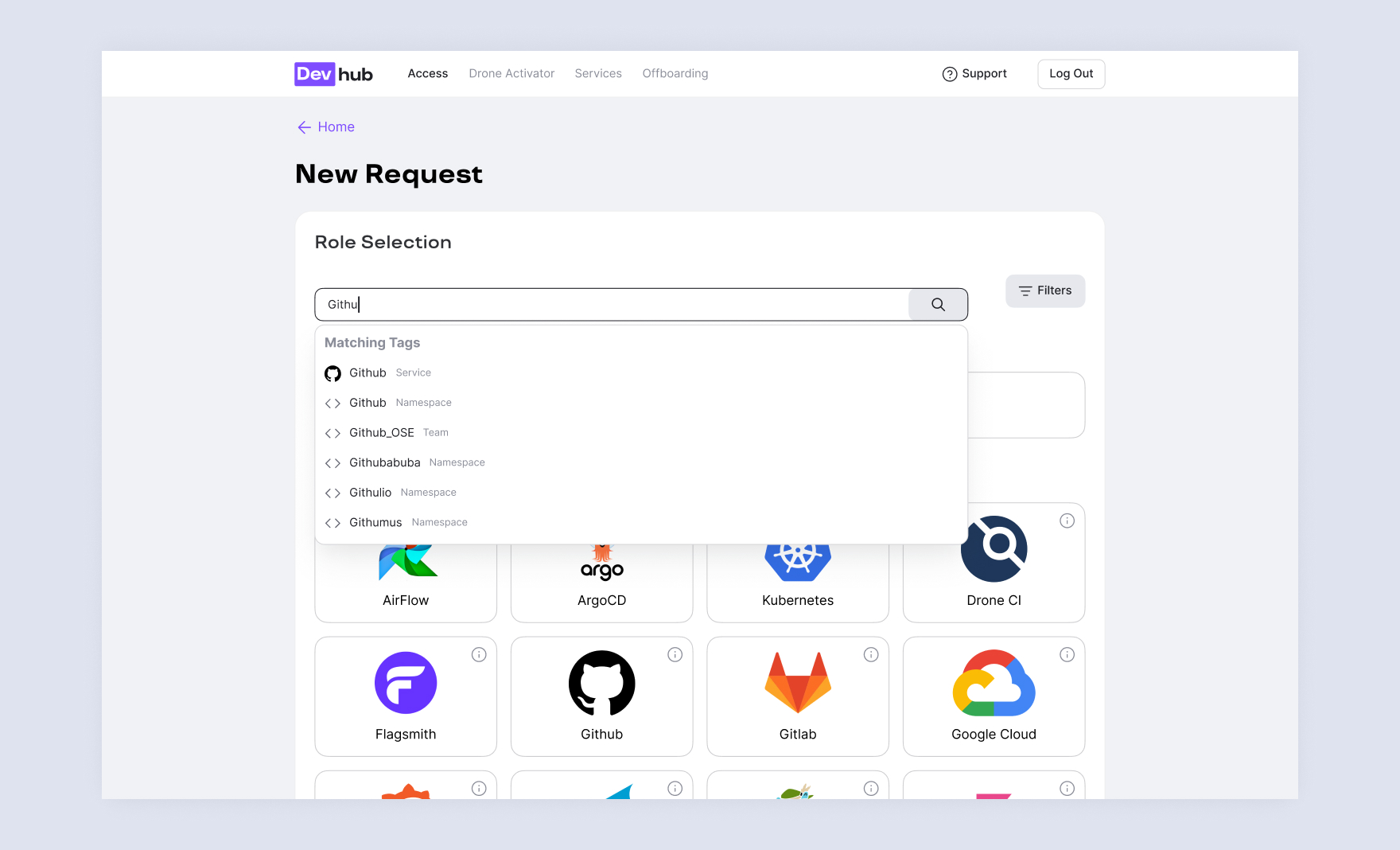
Tags can be added in the search
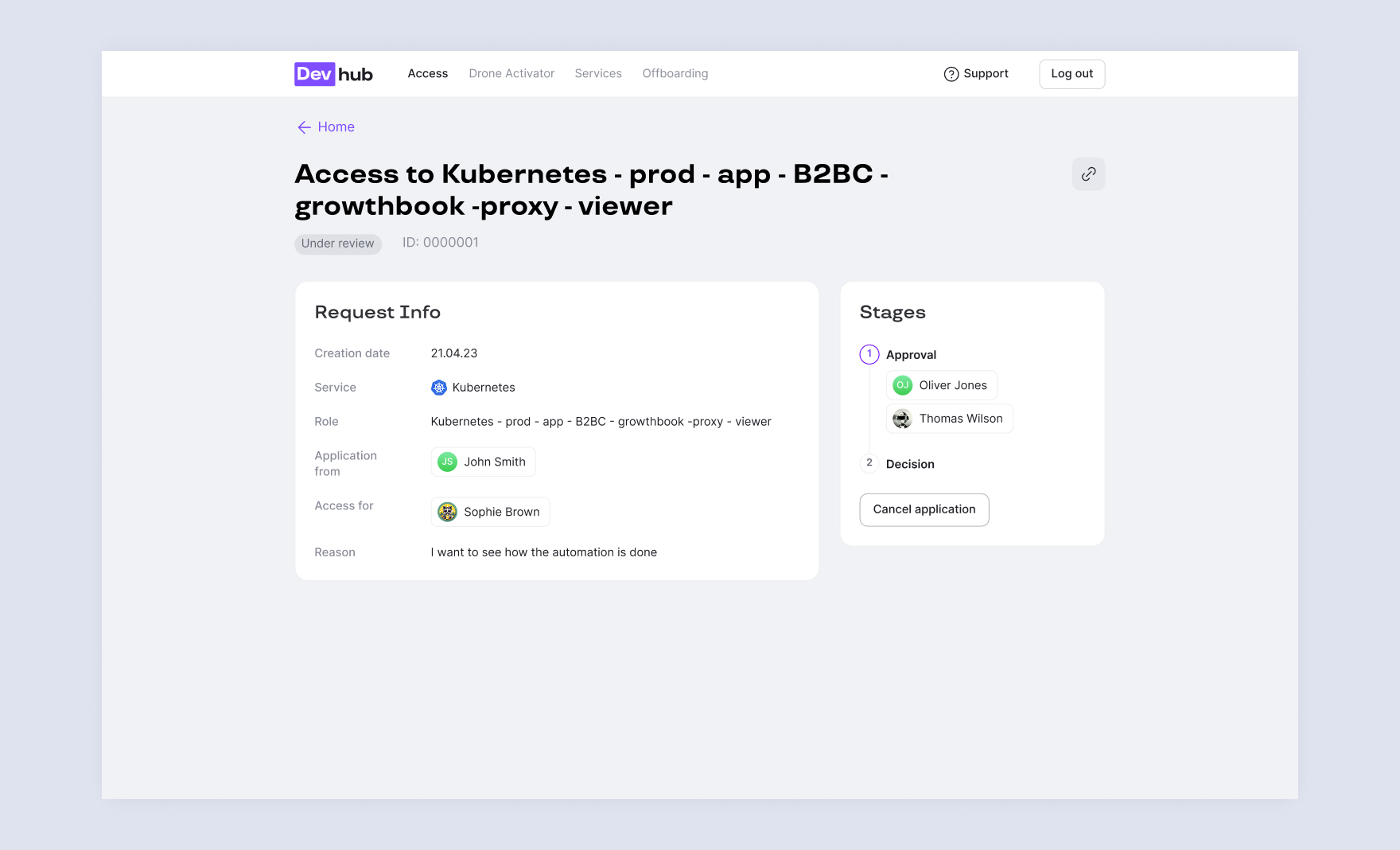
Request information
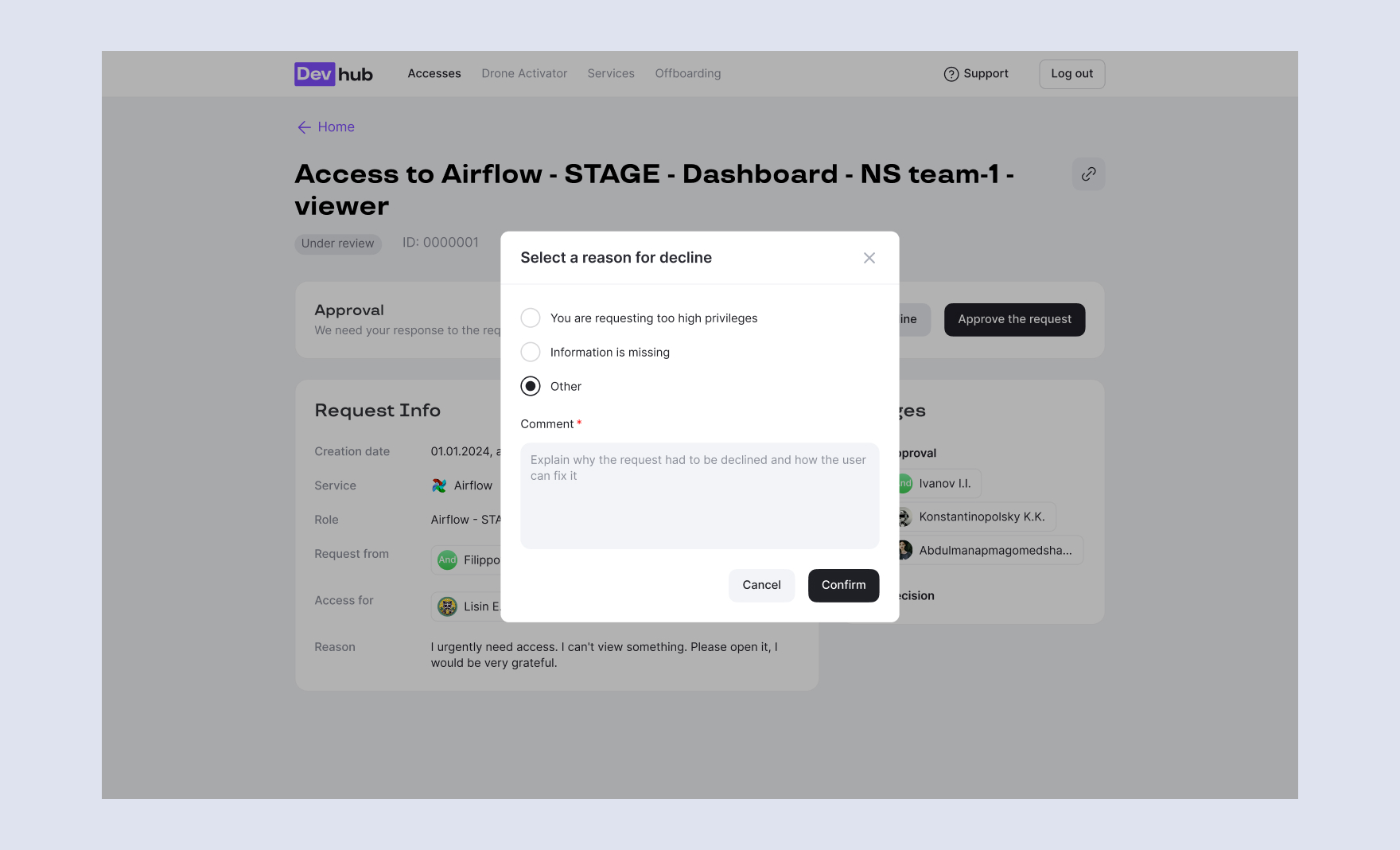
Request rejection. It is necessary to provide a reason for the rejection.
Help Centre
Problem
Needed a simple way to get user feedback or report a bug.
Solution
- Created a simple message submission form with a reason selection.
- Added team contact details for direct communication.
- Added interactive animation to show we're human and informal communication is welcome.
Result
Received 50+ messages from users
Contact Support
Offboarding service (additional feature)
Problem
There was a need to quickly create a tool for removing access for a selected employee.
Solution
- We implemented a very simple tool.
- To prevent errors, we included a mandatory field for password confirmation.
Access removal
Devhub
A portal for developers. An internal product that helps to quickly gain access
Context
At Uzum, all access requests went through Jira Service Management (JSM). Developers regularly faced issues with obtaining access. It was decided to create an internal portal for access requests and subsequently scale it into an infrastructure portal.
MY ROLE
Lead designer
TIMELINE
Apr – Aug 2024
Business goals
- Create a single place to assist developers
- Reduce the burden on DevOps
- Address the issue of slow and inconvenient access issuance
- Consolidate all service data into one knowledge base
Results
Automated the issuance of access rights
Reduced the time to obtain access to just a few minutes
Created a unified database of all services and their responsible parties
Launched a single platform for implementing additional tools
Research
At the initial stage, the client did not understand where to start with the implementation of the portal. Therefore, I conducted extensive research, including over 10 interviews. I surveyed all developer verticals—from QA and frontend to ML. The goal was to understand how the access request process works and what problems arise at different stages.
Key insights
There are issues on both the user side and the DevOps side:
- There is no single place for obtaining access. Six different methods are used to gain access.
- Access through JSM takes an average of 3 to 14 days and requests are often lost.
- There is a lack of information about services and who is responsible for them.
- DevOps lacks personnel to process all requests on time.
As a result of the research, we held an additional meeting with the client and defined the functionality for the MVP.
Conception
Main idea
The portal as an "infrastructure map". It brings together services, environments, and roles, helping users quickly find what they need and request access.
Tone of communication
Friendly and lively — "the portal = your bro, your buddy".
Navigation in the catalogue
By tags, environments, and roles.
Challenges
- The idea was raw, lacking clear objectives.
- The main clients are developers. They have a "technical" mindset.
- The logic of search and the catalogue is very complex.
- Scalability needed to be built in from the start.
- A new team, processes are not established.
Design
Creating a request
Problem
A quick and clear search for roles across all services is needed.
Challenge
Services vary greatly in structure, and roles differ in meaning and context. A standard hierarchical catalog was not suitable.
Solution
- We created a unified flat catalog of all services and roles.
- To facilitate searching, we added filters and tags for each role.
- Tags were duplicated in role names to allow searching by syntax.
- We added a visually clear first level — filtering either by service or by environment.
Creating a request
Tags can be added in the search
Request information
Request rejection. It is necessary to provide a reason for the rejection.
Help Centre
Problem
Needed a simple way to get user feedback or report a bug.
Solution
- Created a simple message submission form with a reason selection.
- Added team contact details for direct communication.
- Added interactive animation to show we're human and informal communication is welcome.
Result
Received 50+ messages from users
Contact Support
Offboarding service (additional feature)
Problem
There was a need to quickly create a tool for removing access for a selected employee.
Solution
- We implemented a very simple tool.
- To prevent errors, we included a mandatory field for password confirmation.
Access removal
Devhub
A portal for developers. An internal product that helps to quickly gain access
Context
At Uzum, all access requests went through Jira Service Management (JSM). Developers regularly faced issues with obtaining access. It was decided to create an internal portal for access requests and subsequently scale it into an infrastructure portal.
MY ROLE
Lead designer
TIMELINE
Apr – Aug 2024
Business goals
- Create a single place to assist developers
- Reduce the burden on DevOps
- Address the issue of slow and inconvenient access issuance
- Consolidate all service data into one knowledge base
Results
Automated the issuance of access rights
Reduced the time to obtain access to just a few minutes
Created a unified database of all services and their responsible parties
Launched a single platform for implementing additional tools
Research
At the initial stage, the client did not understand where to start with the implementation of the portal. Therefore, I conducted extensive research, including over 10 interviews. I surveyed all developer verticals—from QA and frontend to ML. The goal was to understand how the access request process works and what problems arise at different stages.
Key insights
There are issues on both the user side and the DevOps side:
- There is no single place for obtaining access. Six different methods are used to gain access.
- Access through JSM takes an average of 3 to 14 days and requests are often lost.
- There is a lack of information about services and who is responsible for them.
- DevOps lacks personnel to process all requests on time.
As a result of the research, we held an additional meeting with the client and defined the functionality for the MVP.
Conception
Main idea
The portal as an "infrastructure map". It brings together services, environments, and roles, helping users quickly find what they need and request access.
Tone of communication
Friendly and lively — "the portal = your bro, your buddy".
Navigation in the catalogue
By tags, environments, and roles.
Challenges
- The idea was raw, lacking clear objectives.
- The main clients are developers. They have a "technical" mindset.
- The logic of search and the catalogue is very complex.
- Scalability needed to be built in from the start.
- A new team, processes are not established.
Design
Creating a request
Problem
A quick and clear search for roles across all services is needed.
Challenge
Services vary greatly in structure, and roles differ in meaning and context. A standard hierarchical catalog was not suitable.
Solution
- We created a unified flat catalog of all services and roles.
- To facilitate searching, we added filters and tags for each role.
- Tags were duplicated in role names to allow searching by syntax.
- We added a visually clear first level — filtering either by service or by environment.
Creating a request
Tags can be added in the search
Request information
Request rejection. It is necessary to provide a reason for the rejection.
Help Centre
Problem
Needed a simple way to get user feedback or report a bug.
Solution
- Created a simple message submission form with a reason selection.
- Added team contact details for direct communication.
- Added interactive animation to show we're human and informal communication is welcome.
Result
Received 50+ messages from users
Contact Support
Offboarding service (additional feature)
Problem
There was a need to quickly create a tool for removing access for a selected employee.
Solution
- We implemented a very simple tool.
- To prevent errors, we included a mandatory field for password confirmation.
Access removal